
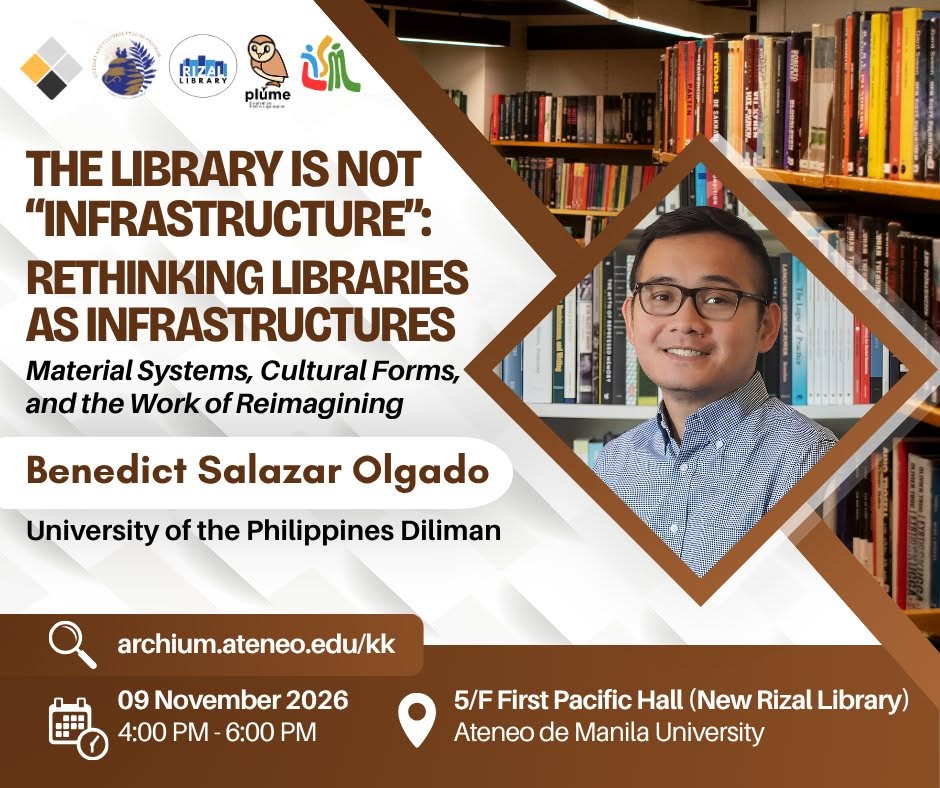
𝗧𝗵𝗲 𝗟𝗶𝗯𝗿𝗮𝗿𝘆 𝗜𝘀 𝗡𝗼𝘁 “𝗜𝗻𝗳𝗿𝗮𝘀𝘁𝗿𝘂𝗰𝘁𝘂𝗿𝗲”: 𝗥𝗲𝘁𝗵𝗶𝗻𝗸𝗶𝗻𝗴 𝗟𝗶𝗯𝗿𝗮𝗿𝗶𝗲𝘀 𝗮𝘀 𝗜𝗻𝗳𝗿𝗮𝘀𝘁𝗿𝘂𝗰𝘁𝘂𝗿𝗲𝘀
𝙈𝙖𝙩𝙚𝙧𝙞𝙖𝙡 𝙎𝙮𝙨𝙩𝙚𝙢𝙨, 𝘾𝙪𝙡𝙩𝙪𝙧𝙖𝙡 𝙁𝙤𝙧𝙢𝙨, 𝙖𝙣𝙙 𝙩𝙝𝙚 𝙒𝙤𝙧𝙠 𝙤𝙛 𝙍𝙚𝙞𝙢𝙖𝙜𝙞𝙣𝙞𝙣𝙜
To register, visit https://go.ateneo.edu/RethinkingLibraries.
𝙆𝙧𝙞𝙩𝙞𝙠𝙖 𝙆𝙪𝙡𝙩𝙪𝙧𝙖, in collaboration with the Literary and Cultural Studies Program, Rizal Library, and PLUME, invites you to a lecture titled “𝗧𝗵𝗲 𝗟𝗶𝗯𝗿𝗮𝗿𝘆 𝗜𝘀 𝗡𝗼𝘁 “𝗜𝗻𝗳𝗿𝗮𝘀𝘁𝗿𝘂𝗰𝘁𝘂𝗿𝗲”: 𝗥𝗲𝘁𝗵𝗶𝗻𝗸𝗶𝗻𝗴 𝗟𝗶𝗯𝗿𝗮𝗿𝗶𝗲𝘀 𝗮𝘀 𝗜𝗻𝗳𝗿𝗮𝘀𝘁𝗿𝘂𝗰𝘁𝘂𝗿𝗲𝘀 (𝙈𝙖𝙩𝙚𝙧𝙞𝙖𝙡 𝙎𝙮𝙨𝙩𝙚𝙢𝙨, 𝘾𝙪𝙡𝙩𝙪𝙧𝙖𝙡 𝙁𝙤𝙧𝙢𝙨, 𝙖𝙣𝙙 𝙩𝙝𝙚 𝙒𝙤𝙧𝙠 𝙤𝙛 𝙍𝙚𝙞𝙢𝙖𝙜𝙞𝙣𝙞𝙣𝙜),” featuring 𝗕𝗲𝗻𝗲𝗱𝗶𝗰𝘁 𝗦𝗮𝗹𝗮𝘇𝗮𝗿 𝗢𝗹𝗴𝗮𝗱𝗼 of the University of the Philippines Diliman. The event will take place on 𝟬𝟵 𝗡𝗼𝘃𝗲𝗺𝗯𝗲𝗿 𝟮𝟬𝟮𝟲, 𝟰:𝟬𝟬–𝟲:𝟬𝟬 𝗣𝗠, 𝗮𝘁 𝘁𝗵𝗲 𝟱/𝗙 𝗙𝗶𝗿𝘀𝘁 𝗣𝗮𝗰𝗶𝗳𝗶𝗰 𝗛𝗮𝗹𝗹 (𝗡𝗲𝘄 𝗥𝗶𝘇𝗮𝗹 𝗟𝗶𝗯𝗿𝗮𝗿𝘆), 𝗔𝘁𝗲𝗻𝗲𝗼 𝗱𝗲 𝗠𝗮𝗻𝗶𝗹𝗮 𝗨𝗻𝗶𝘃𝗲𝗿𝘀𝗶𝘁𝘆.
By examining libraries as both material systems and cultural forms, this lecture explores how infrastructures shape the ways knowledge is organized, understood, and made available to the public. It considers the significance of librarians’ situated expertise while questioning the professional and disciplinary boundaries that influence how libraries are understood and imagined. Ultimately, the lecture calls for a more critical engagement with infrastructure, one that recognizes the knowledge embedded in its everyday practices while allowing new perspectives to reimagine the possibilities of libraries and librarianship.
This event is part of the celebration of the 36th Library Information and Services Month (LISM), spearheaded by the National Library of the Philippines (NLP) in collaboration with the National Commission on Library and Information Services (NCLS) of the National Commission for Culture and the Arts (NCCA).
Admission is free and open to the public. Please bring a valid ID for campus access.
𝗔𝗕𝗢𝗨𝗧 𝗧𝗛𝗘 𝗟𝗘𝗖𝗧𝗨𝗥𝗘
Infrastructure now travels easily across disciplinary boundaries. It names roads and networks, but also the less visible arrangements through which social and cultural life is organized. That mobility, and infrastructure’s usefulness as a boundary object, has been productive. It has also made infrastructure increasingly easy to abstract from the material systems, forms of labor, and professional knowledges through which infrastructures actually endure, both generatively and problematically. Michelle Caswell identified a comparable problem in the humanities’ “archival turn,” where “the archive” became a rich theoretical object even as archival studies and archivists were often sidelined as intellectual interlocutors. This lecture asks what that earlier disciplinary encounter might teach us as infrastructure becomes more central to humanistic inquiry.
My argument is not for a return to infrastructure as merely material. It is, rather, for holding together what too easily gets separated. Infrastructures are technical systems and cultural forms at once. They are built and maintained, but also inhabited, narrated, interpreted, and contested. Libraries make this entanglement especially visible. They are at once physical and informational, institutional and symbolic, practical and epistemic. They do not simply support the circulation of information. They help set the conditions under which some information becomes legible, authoritative, retrievable, and public, while other information is made peripheral, difficult to name, or excluded from the very systems through which it might be encountered.
Reading libraries this way requires a broader conversation among science and technology studies, literary and cultural studies, and library and information science. It also requires taking librarians seriously as more than operators within systems. Their expertise emerges through the daily work of maintaining, negotiating, repairing, and sometimes subverting the infrastructures they inhabit. Yet recognition of professional expertise should not harden into professional gatekeeping. Librarianship, too, must remain open to critique from beyond its boundaries, particularly where professional norms and institutions have naturalized their own assumptions about function, authority, and legitimacy.
Drawing from my ongoing interventions at these intersections, the lecture argues for a more porous politics of expertise—one that takes situated professional knowledge seriously without allowing it to harden into enclosure. It asks the humanities to attend more closely to the material and professional life of infrastructures, while asking librarianship to relinquish any exclusive claim over how libraries may be imagined. Reimagining libraries requires both movements—toward the specificity of how infrastructures are made, maintained, repaired, and dismantled, and beyond the boundaries that have traditionally determined who gets to define what libraries and librarianship are.
𝗔𝗕𝗢𝗨𝗧 𝗧𝗛𝗘 𝗥𝗘𝗦𝗢𝗨𝗥𝗖𝗘 𝗦𝗣𝗘𝗔𝗞𝗘𝗥
𝗗𝗿. 𝗕𝗲𝗻𝗲𝗱𝗶𝗰𝘁 “𝗕𝗼𝗻𝗼” 𝗦𝗮𝗹𝗮𝘇𝗮𝗿 𝗢𝗹𝗴𝗮𝗱𝗼 (https://www.bsolgado.com/) is an Associate Professor at the University of the Philippines School of Library and Information Studies. His work is concerned with the politics of information infrastructures, particularly how documentation systems shape what becomes possible in public life. Much of his research asks what happens when projects of truth, justice, and accountability become entangled with databases, standards, and computational systems that do not merely record the world but participate in producing it.
A major strand of this research examines the datafication of transitional justice. He studies databases as infrastructures of memory, tracing how data, expertise, and documentary practices shape the ways societies contend with violence. Drawing particularly from archival studies, science and technology studies, and human-computer interaction, he has published in leading venues across these fields.
Olgado is the founding director of the Publics, Archives, and Data Lab (PANDA Lab), which serves as a home for his research on the relationships among documentary infrastructures, technology, and public life. Since 2026, he has also served as Deputy Director for Research of the UP Intelligent Systems Center, where he leads an interdisciplinary research agenda on human-centered public information systems. This agenda approaches intelligent systems not simply as technical artifacts but as forms of public infrastructure that mediate how people encounter institutions, access information and services, and exercise rights. He asks how such systems might be designed and governed to be more accessible, trustworthy, and responsive to the publics they are meant to serve. In recognition of his contributions to research and scholarship, Olgado was conferred the distinction of University Social Scientist by the University of the Philippines.
His scholarship is closely tied to his practice as a human rights defender. For much of the past decade, he has worked on the infrastructures through which various groups have documented the Philippines’ so-called “war on drugs.” He previously served as Senior Documentalist and Asia-Pacific Programmes Manager at HURIDOCS (Human Rights Information and Documentation Systems), supporting human rights organizations internationally while helping develop approaches to documentation, data governance, and emerging technologies. Since August 2026, he has served as Director for Documentation, Archives, and Memorialization of the Philippine Truth Commission, where he leads the development of documentary and archival systems through which the Commission builds its truth record and stewards its documentary legacy beyond its time-bound mandate.
Olgado began his career in audiovisual archives and was the founding director of the National Film Archives of the Philippines, now the Philippine Film Archive. There, he worked on landmark restorations including 𝘔𝘢𝘺𝘯𝘪𝘭𝘢 𝘴𝘢 𝘔𝘨𝘢 𝘒𝘶𝘬𝘰 𝘯𝘨 𝘓𝘪𝘸𝘢𝘯𝘢𝘨 (1975/2013) and 𝘖𝘯 𝘔𝘺 𝘞𝘢𝘺 𝘵𝘰 𝘐𝘯𝘥𝘪𝘢, 𝘊𝘰𝘯𝘴𝘤𝘪𝘰𝘶𝘴𝘯𝘦𝘴𝘴 𝘐 𝘙𝘦𝘢𝘤𝘩𝘦𝘥 𝘊𝘩𝘪𝘯𝘢 (1968/2013). His engagement with archives has since moved beyond film preservation into art, curatorial, and critical practice. He consults on archives and collection management for institutional and private art collections, advises artists’ archives including those of Danilo Dalena, At Maculangan, and Roberto Chabet, and collaborates with artists on the possibilities of archival engagement and intervention. He has programmed films for the Museum of Modern Art (MoMA) and served as editor of the NANG issue “Archival Imaginaries” (2021) and the 𝘗𝘭𝘢𝘳𝘪𝘥𝘦𝘭 issue “Philippine Cinema and the Archives” (2018). He is currently working on his book, 𝘙𝘦𝘤𝘰𝘯𝘧𝘪𝘨𝘶𝘳𝘪𝘯𝘨 𝘵𝘩𝘦 𝘌𝘮𝘱𝘪𝘳𝘦 𝘰𝘧 𝘔𝘦𝘮𝘰𝘳𝘺: 𝘚𝘵𝘶𝘥𝘺𝘪𝘯𝘨 𝘵𝘩𝘦 𝘌𝘯𝘵𝘢𝘯𝘨𝘭𝘦𝘮𝘦𝘯𝘵𝘴 𝘰𝘧 𝘍𝘪𝘭𝘪𝘱𝘪𝘯𝘰 𝘈𝘳𝘤𝘩𝘪𝘷𝘢𝘭 𝘗𝘳𝘢𝘤𝘵𝘪𝘤𝘦𝘴, 𝘈𝘳𝘵𝘪𝘴𝘵𝘪𝘤 𝘐𝘯𝘵𝘦𝘳𝘷𝘦𝘯𝘵𝘪𝘰𝘯𝘴, 𝘢𝘯𝘥 𝘋𝘢𝘵𝘢 𝘞𝘰𝘳𝘬.
Olgado received his PhD in Informatics, with a Graduate Emphasis in Global Studies, from the University of California, Irvine, where he was co-advised by Geoffrey C. Bowker and Roderic Crooks. He holds an MA in Moving Image Archiving and Preservation from New York University’s Tisch School of the Arts and a BA in Communication and Social Sciences from Ateneo de Manila University.
Bono loves panda bears.
𝗔𝗕𝗢𝗨𝗧 𝗞𝗥𝗜𝗧𝗜𝗞𝗔 𝗞𝗨𝗟𝗧𝗨𝗥𝗔
𝘒𝘳𝘪𝘵𝘪𝘬𝘢 𝘒𝘶𝘭𝘵𝘶𝘳𝘢 is acknowledged by a host of Asian and Asian American Studies libraries and scholarly networks and indexed in the MLA International Bibliography, Arts and Humanities Citation Index (Clarivate), Scopus, EBSCO, the Directory of Open Access Journals, and the International Consortium of Critical Theory Programs (ICCTP). Read KK issues and learn about submission guidelines and events on https://archium.ateneo.edu/kk or email the editors at kk@ateneo.edu.
Register here: https://go.ateneo.edu/RethinkingLibraries.
- Log in to post comments